FAMOUS MISSIONS

Chang'e 3 ( /tʃæŋˈʌ/; Chinese: 嫦娥三号; pinyin: Cháng'é Sānhào; lit. 'Chang'e No. 3') is a robotic lunar exploration mission operated by the China National Space Administration (CNSA), incorporating a robotic lander and China's first lunar rover. It was launched in December 2013 as part of the second phase of the Chinese Lunar Exploration Program.The mission's chief commander was Ma Xingrui.
The spacecraft was named after Chang'e, the goddess of the Moon in Chinese mythology, and is a follow-up to the Chang'e 1 and Chang'e 2 lunar orbiters. The rover was named Yutu (Chinese: 玉兔; lit. 'Jade Rabbit') following an online poll, after the mythological rabbit that lives on the Moon as a pet of the Moon goddess.
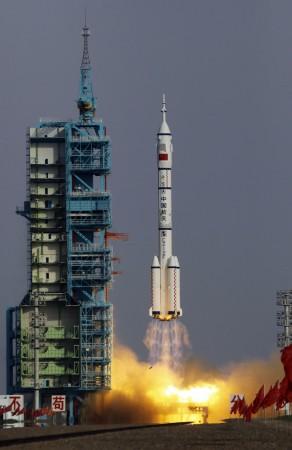
In June, 2012, China implemented the Tiangong I / Shenzhou IX manned rendezvous and docking mission. The objectives of the mission are as follows: to launch Shenzhou IX manned spaceship and carry out an auto and a manual rendezvous and docking respectively with Tiangong 1 target vehicle, thus verify manual rendezvous and docking technology for the first time and further verify auto rendezvous and docking technology.
Shenzhou IX manned spaceship was launched at 18:37 June 16 at Jiuquan Launch Center and the crew includes two male astronauts Jing Haipeng, Liu Wang and one female astronaut Liu Yang. During 13 days' flight in orbit, Shenzhou IX spacecraft conducted one auto rendezvous and docking test and one manual rendezvous and docking.

At 17:38, June 11, 2013, the Shenzhou X spacecraft, with 3 astronauts aboard, blasted off atop a LongMarch 2F carrier rocket from the Jiuquan Launch Center and then entered into the orbit accurately.
At 07:19 June 26, Shenzhou X started up its re-entry procedure, and the reentry module landed precisely at the preset targeting area at 08:07. Then Tiangong I space lab reentered into its orbit for long-term operation
During its on-orbit flight, Shenzhou X carried out a series of space science experiments and technical tests. The three astronauts lived and worked well in orbit.
On November 1, 2011, China launched Shenzhou VIII spacecraft with the aim of performing automatic rendezvous and docking test and making a breakthrough in automatic rendezvous and docking technology. The docking target vehicle is Tiangong 1 that was launched on September 29, 2011.
During September 25-28, 2008, China successfully organized the implementation of Shenzhou VII manned space flight task. The main purpose of this task is to implement the first extravehicular activity by Chinese astronaut

China's Mars rover Zhurong has outlived its three-month life expectancy with all of its predetermined tasks completed, according to the China National Space Administration.